


Somewhere right now, someone is lying face-down on a massage table with their jaw clenched, thinking a very specific thought: this is too much, but I don't want to be difficult.
Then they say nothing. For forty more minutes. They pay, they tip, they walk out sore in a way that is not the good kind of sore, and somewhere over the next week they quietly decide that massage "isn't really for them."
That entire outcome was preventable with about six words.

Why almost nobody speaks up
If you have ever stayed silent through pressure that was wrong for you, you are in extremely normal company. The reasons are predictable once you list them out:
It feels like criticism. Your therapist is working hard, breathing audibly, clearly putting effort in. Saying "that's too much" sounds uncomfortably close to saying "you're doing this badly."
The no-pain-no-gain myth. A lot of people genuinely believe that if it doesn't hurt, it isn't working. So they endure, on purpose, thinking that's the deal.
You don't have the words. "Softer" is vague. "Too hard" is blunt. Most people have never been given a script, so they default to silence.
You booked a service name and assumed it was fixed. "I asked for deep tissue, so I guess this is deep tissue." Deep tissue is a technique, not a fixed intensity setting.
You are in a genuinely low-power position. Face-down, under a sheet, half undressed, eyes closed. That is not the posture most of us find it easy to make requests in.
None of these are silly. But all of them are working against you, because the one thing your therapist cannot do is feel your body from the inside. The American Massage Therapy Association is direct about this: clients have the right to consent to the level of pressure used and to request adjustments at any point during the session. Not at the start. Not at the end. Any point.
Reframe it: you're not complaining, you're filing a bug report
Here is the mental shift that makes this easy, and I say this as someone who thinks in these terms constantly.
A skilled therapist is reading a lot of information already — tissue resistance, temperature, how your shoulder moves, whether your breathing just changed. That is real skill. But it is still incomplete data. They know what your back is doing. They do not know that the spot under your left shoulder blade currently feels like a lit match.
Telling them is not a complaint about their work. It's the missing input. And a therapist who has been doing this a while would genuinely rather hear it in minute three than read it in a review three days later.
The actual words to say
The trick is to be specific and directional instead of just negative. "Softer" leaves your therapist guessing how much softer. A number or a direction removes the guesswork.
When it's too hard
"Can you ease off about twenty percent on that side?"
"That's a bit much for me — same spot, lighter."
"My shoulders can take that, but please go gentler on my lower back."
"Let's stay off that spot for now."
When it's too soft
"That feels nice, and I think I can handle more pressure."
"Can you go deeper right there, same slow speed?"
"I usually like it firmer than this — feel free to lean in."
When the pressure is fine but the location isn't
"The sore part is about two inches lower."
"That's it. Stay there."
That last one matters more than people expect. Therapists get plenty of vague feedback and almost no confirmation. Telling someone they found the right spot means they can stop hunting and start working.
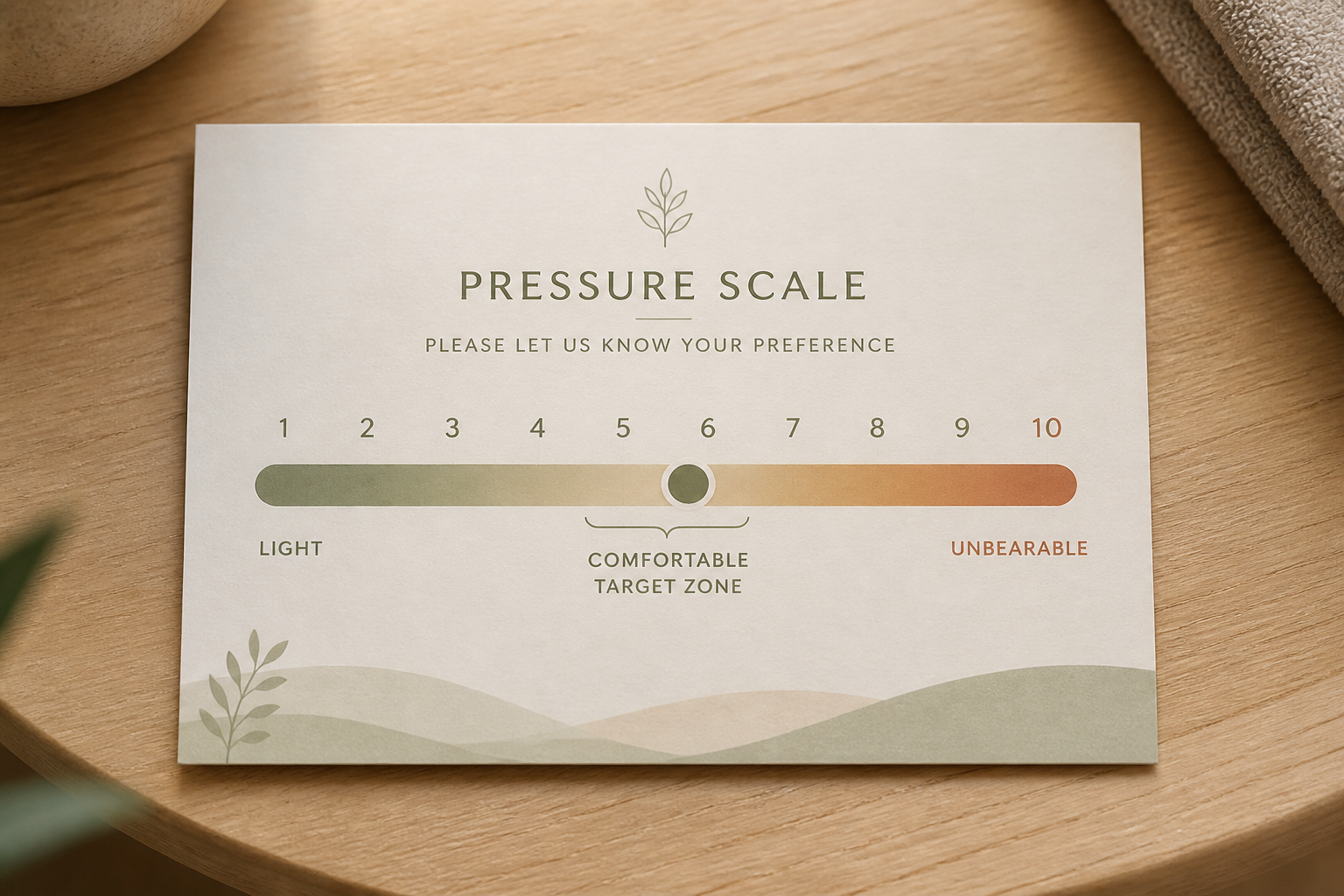
If words fail you, use numbers
Agree on a scale before the session starts. Something as simple as, "if ten is unbearable, keep me around a six" gives your therapist a target they can actually aim at, and gives you a fast way to communicate mid-session without composing a sentence. "That's an eight" takes two syllables and no social courage.
When to say it
The first few minutes are the best window. Many therapists are trained to check in early precisely because early feedback shapes the whole session, and the phrasing they're taught to use is deliberately open — more like "would you like more pressure, less, or is this about right?" than a yes-or-no "is the pressure okay?" If you get asked that, answer it honestly instead of reflexively saying it's fine.
If they don't ask, you can still speak first. There is no rule that the therapist has to open the conversation.
After that, say something the moment the pressure stops working for you. Mid-stroke is fine. You are not interrupting a performance.
The one moment that does not help is the doorway at the end, when they ask how it was and you say "a bit strong, actually." At that point you've written a review, not made an adjustment.
How to tell productive discomfort from real pain
Some massage work is meant to feel like something. The useful distinction isn't intensity, it's quality — and your body gives you clean signals if you know what to check.
Usually fine: a dull, achy, oddly satisfying pressure. The kind where you can still breathe normally and part of you wants them to keep going.
Not fine:
You're holding your breath or breathing in short bursts.
You're bracing, gripping the table, or curling your toes.
You're flinching or pulling away from the hands.
The sensation is sharp, electric, burning, numb, or tingling rather than achy.
You are counting down the seconds until they move on.
The breath test is the most reliable one. If you cannot breathe normally through it, it's too much for your body right now, regardless of what your pain tolerance was last month. Sharp, electric, numb, or tingling sensations are a different category — that's a stop-and-mention, not a dial-it-back.
If saying it out loud is genuinely hard
For some people this isn't a vocabulary problem, it's a nervous-system one. Speaking up while lying face-down and vulnerable is legitimately difficult. Workarounds:
Write it on the intake form. "Prefers medium pressure, sensitive lower back" does most of the work before anyone touches you.
Set up a hand signal. "If I raise my hand, that means ease off." No talking required.
Say it once at the door. A single sentence before you lie down — "I bruise easily, so please start light and we'll build up" — is easier than any mid-session request.
Know you can end it. You are allowed to stop a session entirely. Rarely necessary, but knowing the exit exists makes the smaller requests feel much less dramatic.
Therapists are also taught to watch for the non-verbal version — sudden tensing, breath changes, going very still. Many will notice and ask. But that's a backup system, not a substitute for telling them.
What a good response looks like
How your therapist reacts is genuinely useful information about them.
Good: immediate adjustment, no defensiveness, and a follow-up check a minute later to confirm the new pressure landed right.
Not good: arguing with you, explaining that you need this intensity, invoking no pain no gain, easing off for thirty seconds and then drifting straight back, or making you feel like you failed a toughness test.
The second list isn't a matter of style. Adjusting pressure on request is basic professional practice. If it doesn't happen after you've asked clearly, that's a fit problem — and worth mentioning in a review so the next person knows.

If you already stayed quiet and now you're sore
Mild soreness for a day or two after firm work is common and usually behaves like ordinary post-workout ache: it peaks, then steadily improves. Gentle movement, warmth, water, and skipping the heavy workout for a day generally cover it.
What isn't ordinary: pain that keeps getting worse instead of better, visible bruising, swelling, numbness, or soreness that's still going strong after several days. That's worth a conversation with a healthcare professional rather than waiting it out, and worth telling your therapist about before you book again so the next session starts somewhere gentler.
Then say the thing next time. Six words, minute three, and the whole session goes differently.