A massage therapist can build a business without ever opening a spa.
The idea is straightforward, yet its significance is often underestimated.
In one market, an independent therapist may carry a table from apartment to apartment. In another, clients book through an app and a centrally managed network sends vetted practitioners to homes and hotels. Somewhere else, mobile massage overlaps with disability support, corporate wellness, resort work, or clinical practice. And in many cities, the same practitioner could instead rent a room, open a small spa, join a larger establishment, or eventually operate both.
So the familiar question—home service or physical spa?—does not have one global answer.
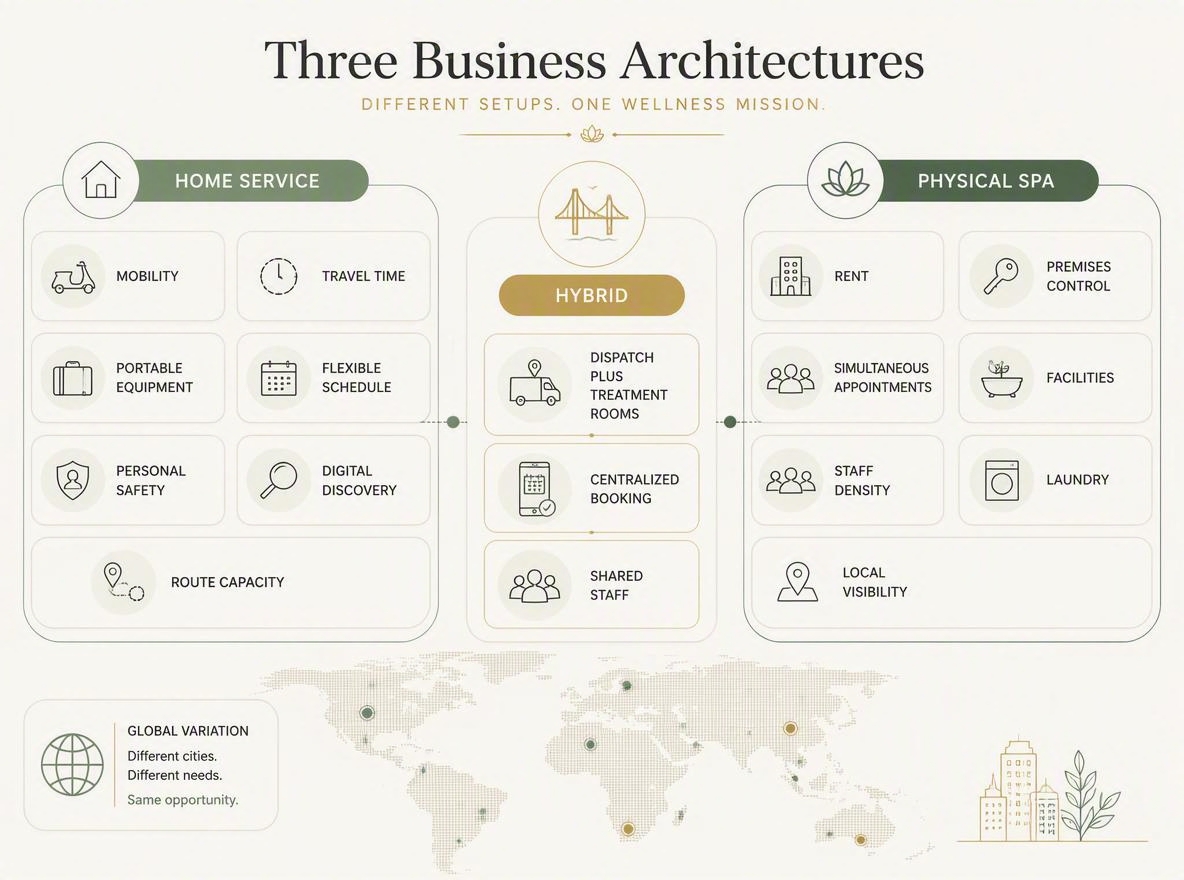
It is not simply a choice between a cheaper business and a more expensive one. Home service trades premises costs for movement, logistics, safety, portable equipment, marketing, and a working environment you do not control. A physical spa accepts rent, fit-out, utilities, permits, staffing, and fixed operating obligations in exchange for treatment capacity, infrastructure, visibility, and control.
The stronger model is not simply the one with fewer costs, but the one whose costs, risks, and responsibilities align with the business you genuinely aim to create.
“Home service” means very different things around the world.
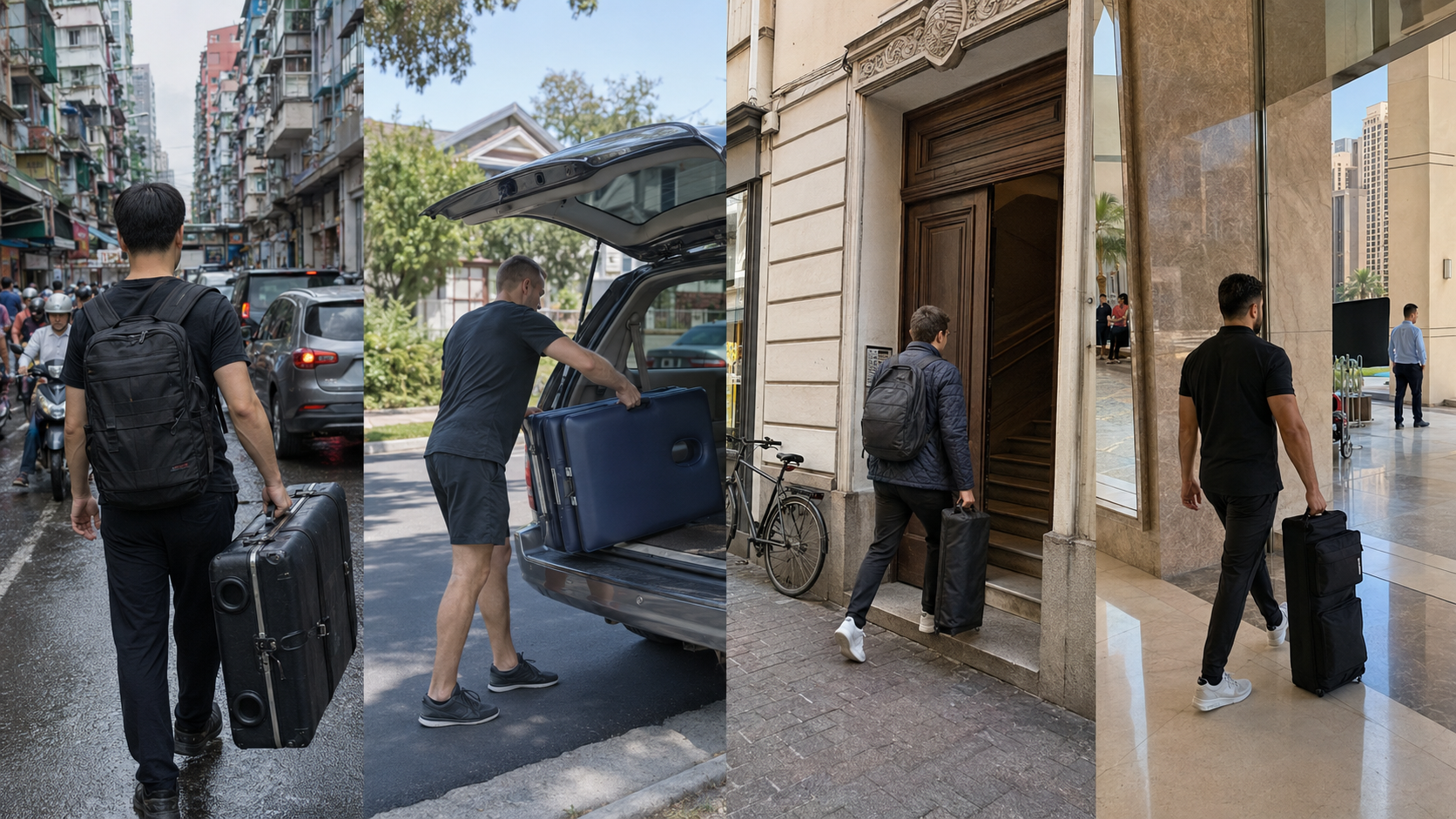
The simplest version is a solo practitioner who travels to clients. But that is only one form of mobile massage.
In the United States, the Bureau of Labor Statistics reports that 36 percent of massage therapists were self-employed in 2025 and explicitly notes that some travel to clients' homes, events, and other sites while others work from their own homes. That tells us mobility is not a fringe exception in a large professional market.
In the United Kingdom, Urban says it has delivered more than one million at-home treatments. In Australia, Blys reports more than 150,000 customers and tens of thousands of verified reviews for mobile massage and beauty delivered to homes, hotels, and offices. Australia's Association of Massage Therapists has even published a position statement expressly addressing mobile massage practice.
India provides another model altogether: Urban Company's Delhi NCR spa-at-home service shows millions of bookings in a single metropolitan market. In Dubai, the same platform records hundreds of thousands of home-massage bookings across its men's and women's categories.
Those numbers should not be compared as though they are national market shares; they come from different companies, categories, and geographies. What they do establish is something more useful: mobile massage can be a mature service model, not simply the low-budget stage before opening a spa.
A physical spa buys control; home service buys portability.
Consider what changes when the client comes to you.
You control the room. You choose the massage table, lighting, sound, temperature, storage, sanitation process, linen workflow, waiting area, restroom access, treatment-room reset, and how much equipment is permanently available. If several therapists work at the same site, they can share supplies, reception, laundry systems, management, and support.
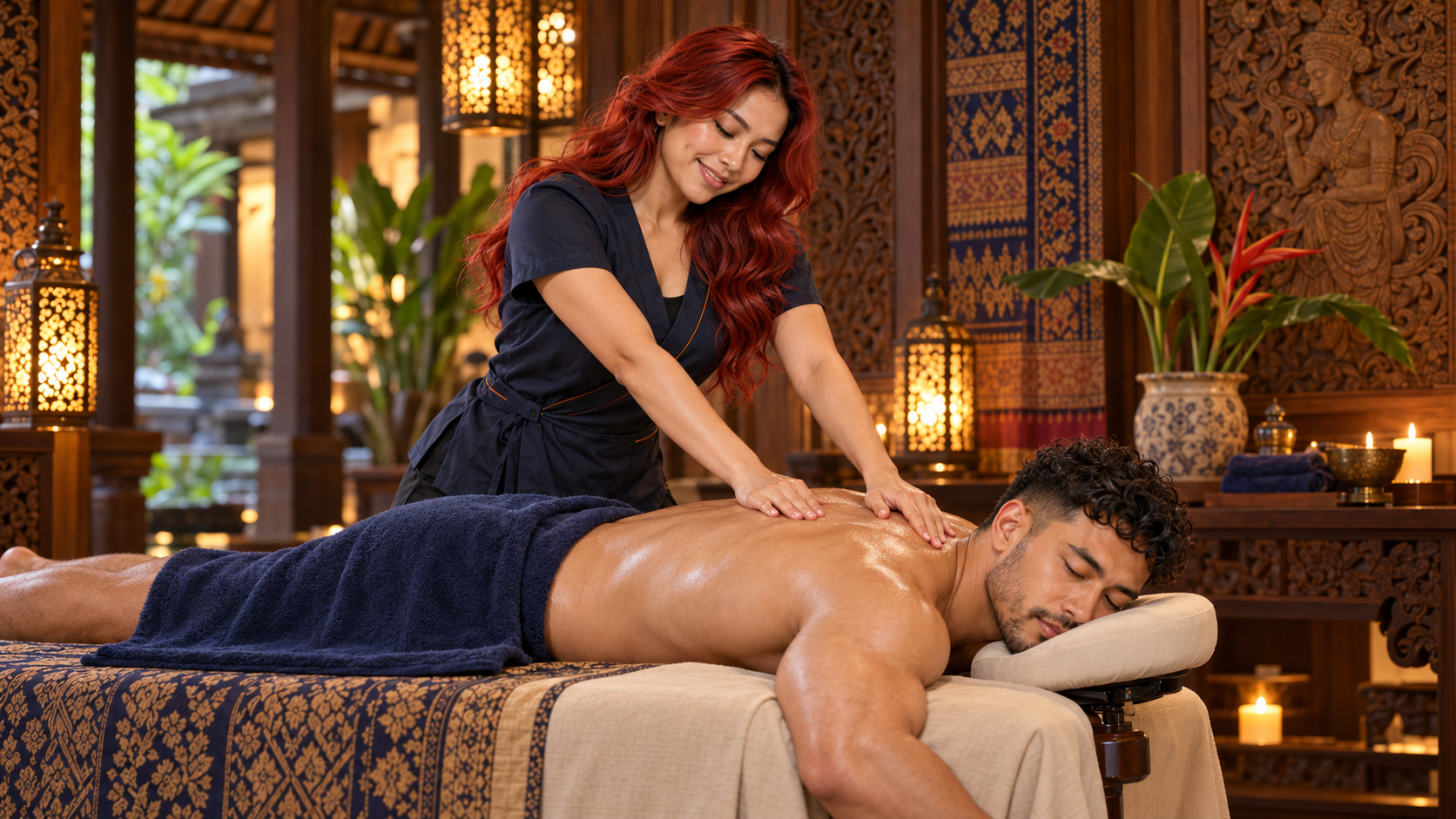
A physical spa can also sell experiences that are difficult to reproduce in a living room: couples rooms, wet areas, showers, sauna, hydrotherapy, larger treatment equipment, retail displays, relaxation lounges, and a more deliberately designed atmosphere.
Home service gives up much of that environmental control.
Yet it gains an advantage that a building cannot offer: portability.
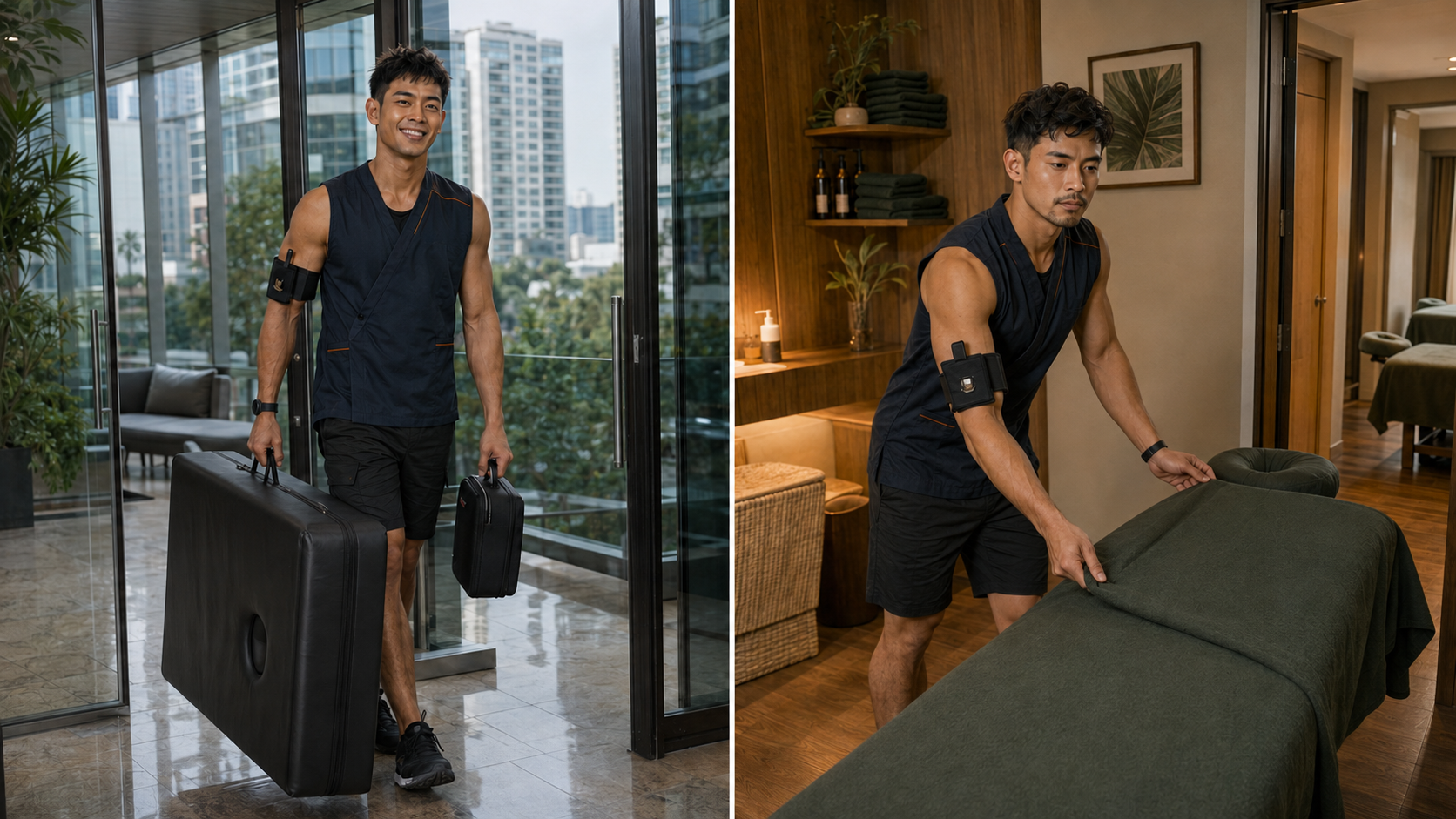
You can go to a client who cannot easily travel. You can serve homes, hotels, workplaces, events, or residential-care settings where appropriate. You can change your service area. You may be able to start with less fixed capital. You can more easily reduce or expand your working hours. And if your reputation follows you, your business can move without relocating a storefront.
Each model, in effect, secures a different kind of control.
A spa controls the environment. A mobile practitioner controls where the business can go.
Travel time remains a business cost, even when it does not arrive as an invoice.
This is among the most common oversights when comparing the two models.
A physical spa has visible occupancy costs. Rent arrives as a bill. Electricity arrives as a bill. Maintenance arrives as a bill.
Travel time is less obvious because nobody invoices you for an hour lost between clients.
Yet that hour is still spent.
Suppose two therapists each perform four one-hour massages. One works in a spa where clients arrive every 90 minutes. The other works across a city and must travel, park, enter buildings, set up, pack down, and recover from delays. Both performed four hours of massage, but their working days are not economically equivalent.
Geography determines how painful that difference becomes.
A dense Asian megacity with severe congestion can make a five-kilometer appointment change more expensive than a much longer trip in a city with faster roads and predictable parking. Rural practice presents the opposite problem: less congestion, but longer distances between clients.
This is why any global discussion of convenience must ask: convenient for whom?
For the client, home service removes the journey.
For the practitioner, it often means absorbing the journey.
The economics shift when a solo practitioner transitions into a business.
For a solo therapist, the most important capacity limit is personal.
Massage is physical work. The U.S. Bureau of Labor Statistics notes that many massage therapists cannot perform massage services eight hours per day, five days per week because of the strength and endurance involved. That basic human constraint exists regardless of country.
Once a practitioner's schedule fills, growth becomes more complicated.
You can raise prices. Narrow your service area. Reduce travel. Add higher-value services. Keep a waiting list. Become more selective. Or you can add another therapist.
The moment another therapist joins, the business question evolves.
You now need standards, scheduling, quality control, client allocation, payment handling, safety procedures, communication, equipment, and a way to ensure that a client who booked your brand doesn't receive an entirely different level of service.
That can happen without a spa. A home-service company can scale through dispatch and territory.
A physical spa scales differently: through rooms, staffing, utilization, operating hours, and eventually additional locations.
It is therefore an oversimplification to suggest that home service is inherently small and spas are inherently scalable.
Home service scales through logistics. Physical spas scale through capacity.
Apps have changed what a mobile massage business can look like
The old picture of home service was a practitioner carrying a phone number and a table.
That model still exists. But digital services have added another layer.
A client can now search by service, location, rating, availability, therapist profile, price, and sometimes therapist gender or other preferences. A platform can centralize payment, scheduling, identity checks, reviews, customer support, rebooking, and dispatch. This helps explain how home-service massage can become large enough to support millions of bookings without owning millions of treatment rooms.
That does not mean a platform removes the underlying work.
The table still has to reach the client. The practitioner still has to travel. Cancellations still create gaps. Safety still matters. The service still happens in an environment the provider does not fully control.
Technology does not eliminate operational complexity; it reorganizes it.
This is also where a discovery platform such as Massage Nexus can be useful without dictating the practitioner's business model. An independent mobile therapist can build a profile around service areas, services, availability, ratings, reviews, and booking information. A physical spa can use the same system to present its location, facilities, staff, services, hours, and booking options. The value is not that one model gets better promotion. It is that both can be understood on their own terms.
Safety belongs in the business model, not in the footnotes.
A treatment room inside your own premises is a known environment.
A client's home is not.
That difference affects both therapist and client.
For the therapist, home service may require identity checks, address verification, emergency contacts, check-in and check-out systems, controlled service areas, late-night policies, incident procedures, and rules about when a booking should be refused.
For the client, inviting an unknown practitioner into a private residence also requires trust. Platforms usually respond with identity verification, ratings, provider screening, customer support, and traceable bookings because the home itself removes some of the public visibility that a storefront provides.
Australia's professional guidance on mobile massage illustrates this clearly: its Association of Massage Therapists treats in-home service as legitimate professional practice while still emphasizing insurance, first aid, hygiene, work health and safety, professional standards, and record-keeping.
Home service should not be presented as a model with no overhead or complications.
There is infrastructure involved; some of it exists in procedures rather than in physical walls.
Rules do not travel well across borders.
This is where global business advice can become risky if it is delivered with too much certainty.
Rules do not travel well across borders.
This is where global business advice becomes dangerous if it sounds too confident. Massage regulation, business registration, professional licensing, insurance, taxation, employment law, zoning, health requirements, home-business restrictions, and spa licensing can differ not only between countries but between states, provinces, emirates, municipalities, and occupational contexts. The final takeaway is simple: don't choose home service or a physical spa out of habit or assumption. Choose the model whose costs, risks, responsibilities, and rules fit the business you are actually trying to build.
A practitioner in one U.S. state may face a professional licensing structure unlike another state. A premises-based spa in London can face local treatment-premises requirements that do not resemble rules in Sydney. Dubai home service functions within a very different licensing and labor environment from Manila or Delhi. India's local spa rules can differ by city and state.
The global lesson is not simply a checklist of permits.
It is this:
Do not assume that avoiding a storefront means avoiding regulation, and do not assume that opening a storefront creates the same obligations everywhere.
Before investing, the practitioner has to identify which rules attach to the person, which attach to the business, which attach to the premises, and which attach to employees or contractors.
A spa can make your personal technique harder to scale
This sounds backward. Shouldn't opening a spa make scaling easier?
Operationally, yes. Creatively, not always.
Some therapists become popular because clients want that particular therapist's hands, pacing, pressure, intuition, communication, or way of combining techniques. The practitioner is not simply delivering the brand. The practitioner is the brand.
That works beautifully as long as demand fits one person's calendar.
It becomes a problem once ten people want appointments, and you can only take four.
Opening a spa does not automatically transfer your reputation to the therapists you hire. You need to train people, define standards, supervise quality, and decide how much of your method can or should be taught.
Some practitioners will worry that employees may learn their approach and later compete with them. That risk exists in many skilled service businesses. But the deeper question is not whether knowledge should be protected at all costs.
It is whether you actually want a business that can operate beyond your personal labor.
There is no loss of stature in deciding that the answer is no.
A highly regarded independent practitioner with a controlled client list can have a better career than an unhappy spa owner carrying debt, staff problems, and a business they never wanted to manage.
Hybrid may be the most underrated answer.
The choice is usually framed as an either-or decision because that makes a clean headline.
In reality, businesses are more nuanced.
A spa can serve walk-in and appointment clients while dispatching therapists for home and hotel bookings. An independent therapist can rent a treatment room on selected days and travel on others. A home-service company can keep a central office, laundry area, equipment storage, or therapist base without operating public treatment rooms.
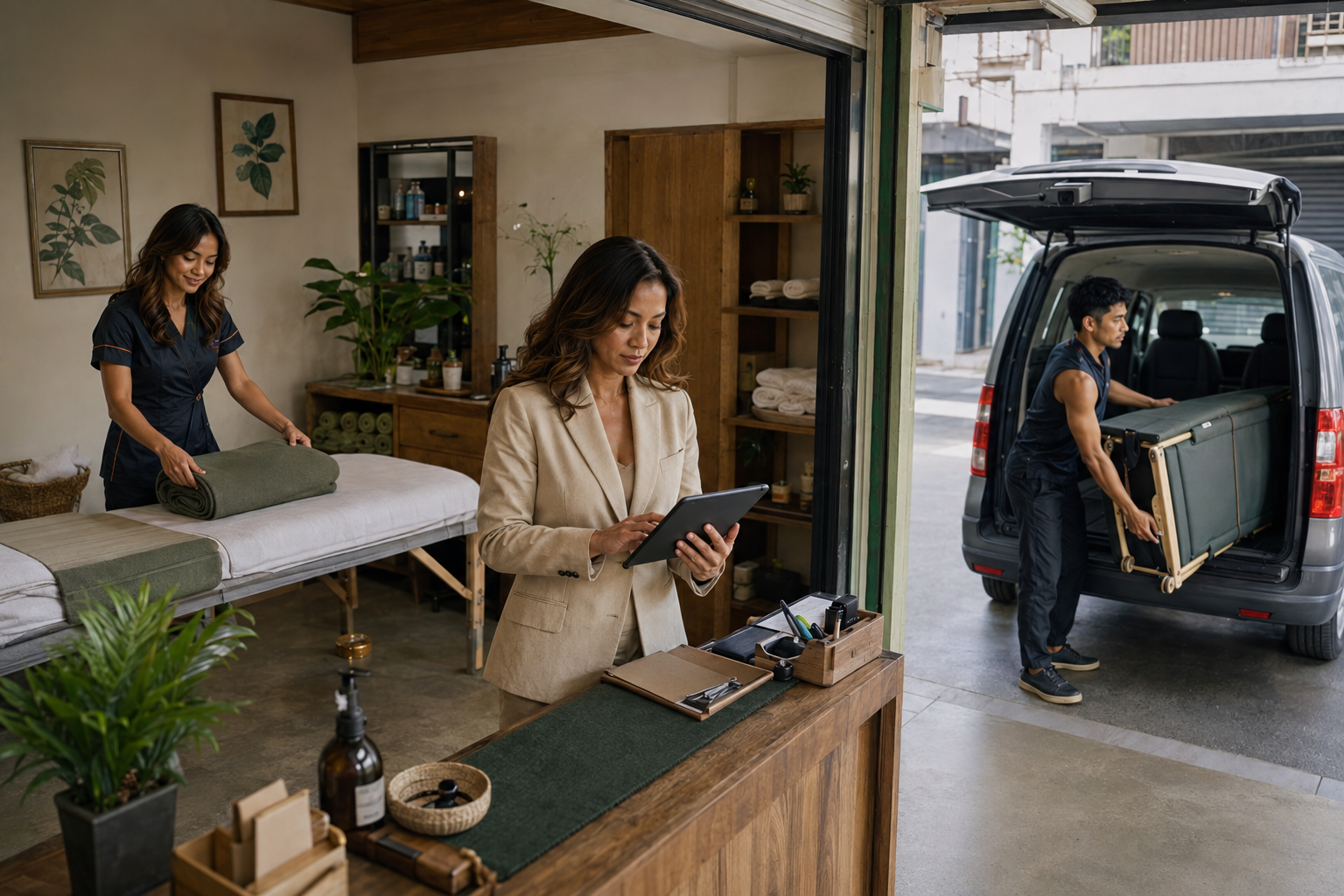
Hybrid models can solve several weaknesses at once. A spa provides a controlled base. Home service extends geographic reach. A practitioner can keep loyal mobile clients while gradually testing whether demand is strong enough to support premises.
However, hybrid models also combine complexity.
You are now responsible for managing both rooms and routes.
It becomes important to assess whether the additional channel increases useful capacity or introduces new avenues for disorganization.
The best model depends on what you want to become
If you primarily want an independent practice, home service may remain the stronger model for years. It can preserve flexibility, keep fixed overhead lower, and keep the business closely connected to your schedule and reputation.
If you want a destination, multiple therapists working simultaneously, controlled facilities, stronger service standardization, and revenue that can continue while you personally are not treating a client, a physical spa may be worth the larger commitment.
If your local market already has strong platform-driven mobile demand, an organized home-service business may scale further than you expect.
If rent is affordable, travel is difficult, and clients value facilities or atmosphere, premises may become attractive earlier.
And if the market supports both, hybrid may be the most rational path.
There is no universal winner because the variables are not universal.
Labor costs change. Rent changes. Traffic changes. Regulation changes. Client expectations change. Housing patterns change. Cultural comfort with inviting a practitioner into the home changes. The availability of booking platforms changes. Even the meaning of “spa” changes from one market to another.
This is why the global answer should not be framed as a verdict.
Home service asks whether you can build a business around movement. A physical spa asks whether you can build one around a place. The better start is whichever structure can carry your demand without asking you to become an operator you never wanted to be.