
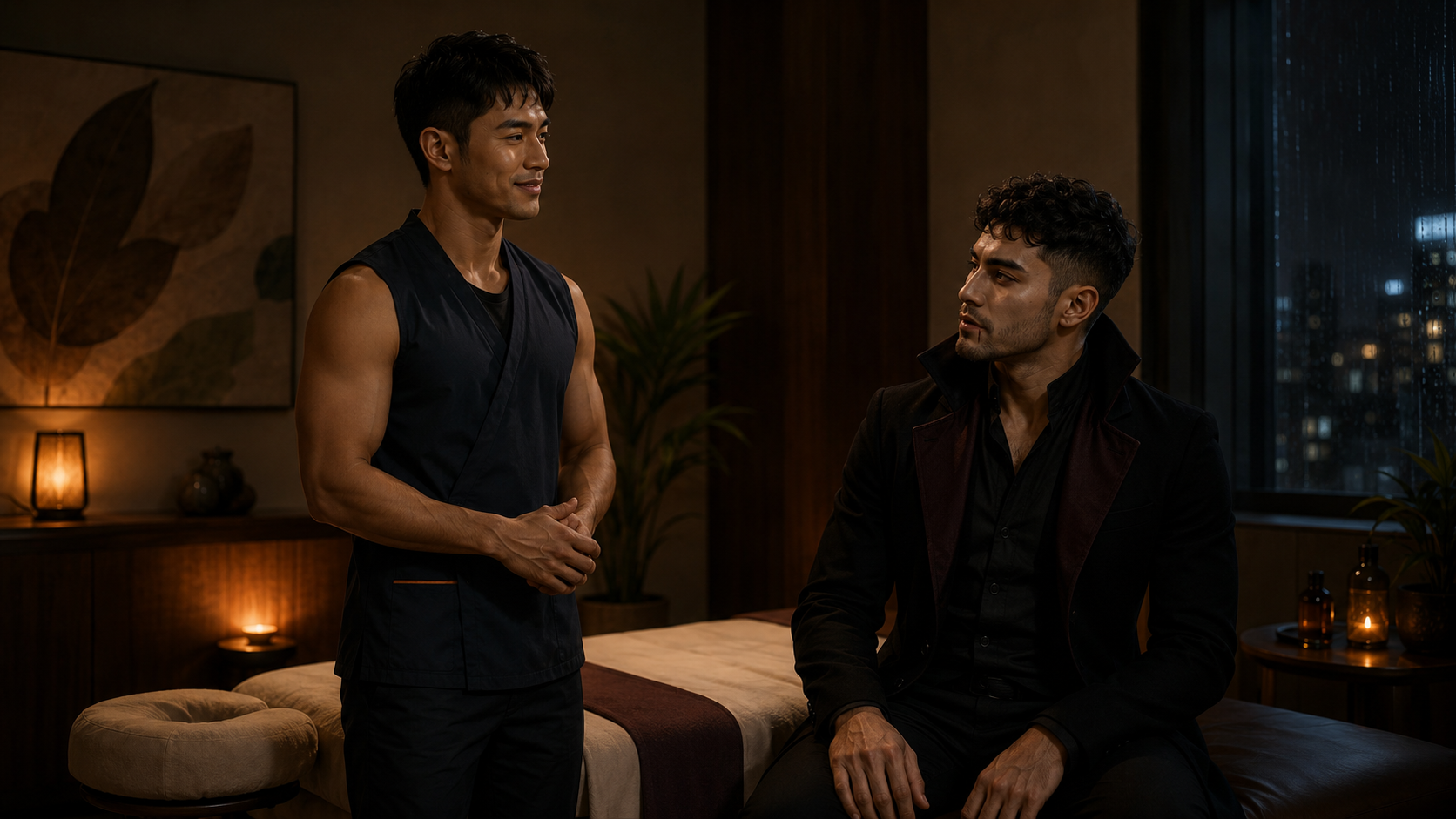
A vampire books the last appointment of the night. Sensible. The client arrives pale, immaculate, still, and lists “upper-back tension” on the intake form in writing that suggests several centuries of practice.
The first mistake would be treating this like an ordinary deep-tissue session with moodier lighting. Instead, the real question is how those assumptions fail once the client is unmistakably a vampire.
If we accept the usual list—cold skin, little or no circulation, unusual strength, rapid healing, nocturnal habits, and a complicated relationship with mirrors—then the ordinary logic of massage begins to slip. Each trait quietly alters what the therapist expects from the body on the table.
The therapist is left treating an entirely different body system, not simply a human client with unusual cheekbones.
First problem: cold tissue does not behave like warmed human tissue
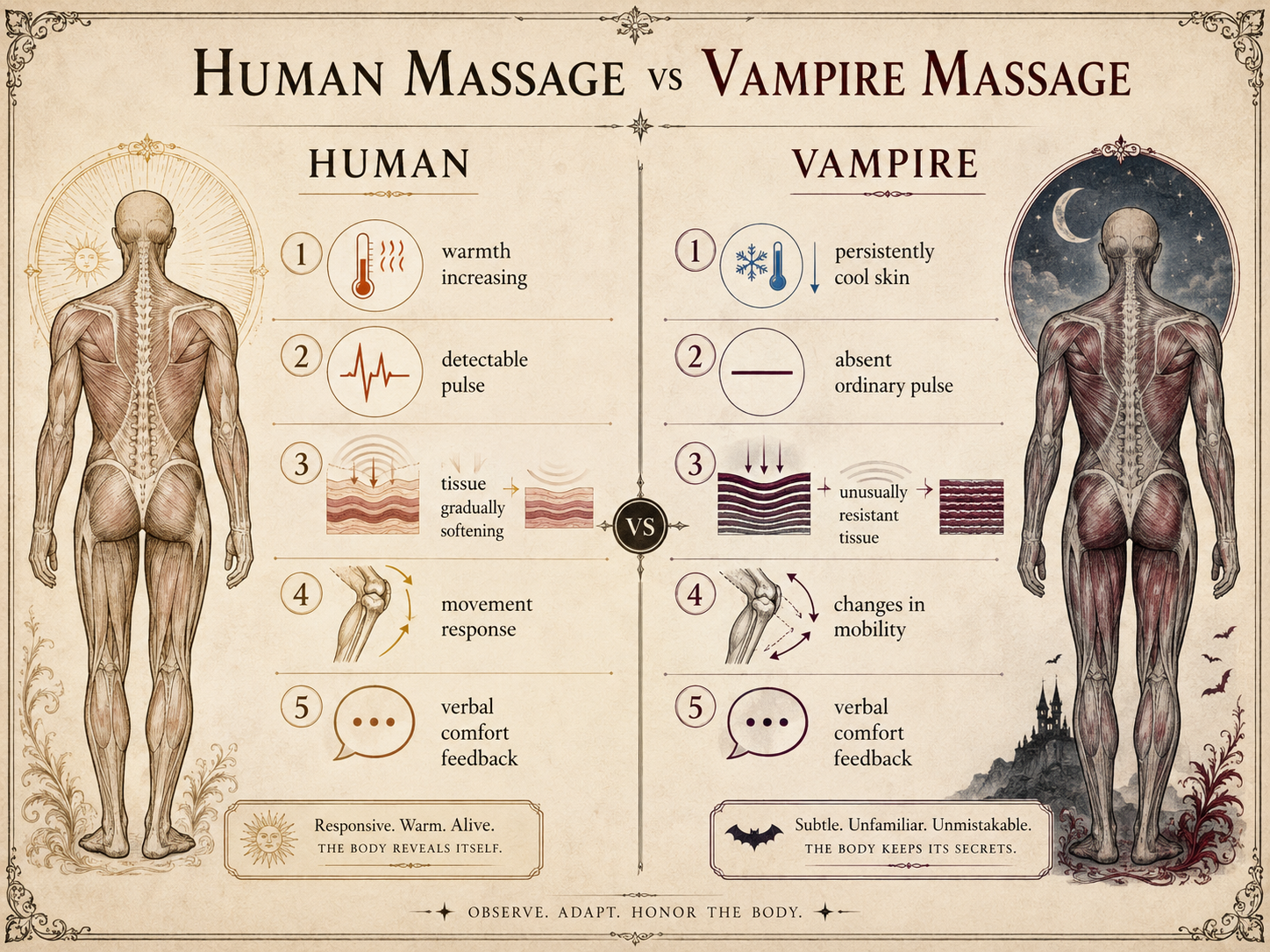
Massage with human clients often begins with broad contact, relying on warmth, circulation, and gradual loading to help the body settle. A vampire’s skin, remaining cold, may never offer that familiar feeling of warmth beneath the therapist’s hands.
So the therapist cannot use temperature as a reliable progress signal.
The session would depend more on mechanical feedback: resistance, density, range of motion, the client’s verbal response, and whether the tissue becomes pliable even if it remains at something like 'crypt at midnight' temperature.
A heated table may be more comfortable for the therapist than for the client. Heated stones seem unnecessary, unless the client finds the ritual pleasing.
Second problem: forget the usual circulation language
If the client has no ordinary heartbeat or blood circulation, then the usual promise that massage 'improves circulation' becomes quietly irrelevant.
The goals shift: reduce mechanical stiffness, improve movement, ease the tension that accumulates in posture, and offer a measure of sensory rest.
This is actually a useful reminder for human massage too. A treatment goal should describe what the session is trying to change, not just echo generic wellness phrases because they came printed on the brochure. For example, compare: "We will unblock your flows of rejuvenating energy" (brochure promise), versus "We aim to reduce your shoulder tension so you can reach the top shelf without pain" (actual goal). The first could be printed on a packet of bath salts; the second actually tells you what might feel different after the session.
Where, then, would a vampire actually carry tension?
Start with the neck and upper back.
Centuries of high collars, cape posture, leaning over sleeping victims, reading legal documents by candlelight, and silent observation from balconies would create a particular upper-quarter workload.
The levator scapulae and suboccipitals would not be grateful.
The hips and lower back would not fare much better. Coffins, even the velvet-lined ones, are not known for lumbar support.
A vampire who spends daylight hours lying rigidly supine may arrive with hip stiffness, reduced spinal variety, and the kind of low-back complaint normally associated with twelve hours of air travel. Imagine Dracula himself emerging from his coffin after centuries—he would likely need more than a stylish cape to ease that lumbar discomfort. The flight wasn't just long-haul; it started in 1437 and still hasn't landed.
Pressure would need to be measured differently.
If vampire muscle is denser and stronger than human tissue, 'firm pressure' may mean little to the client and much to the therapist.
The solution is not to turn the session into a contest of strength.
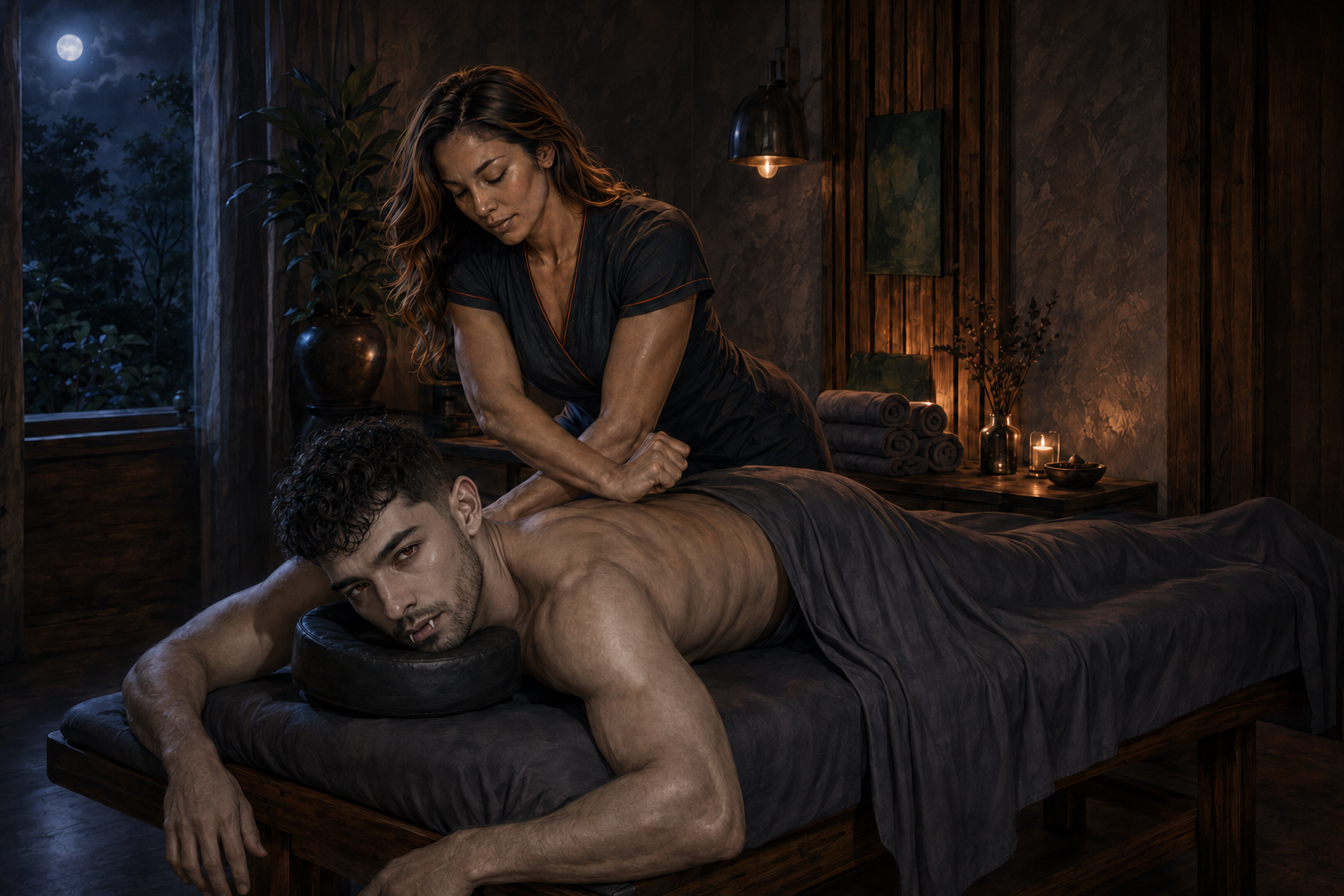
Leverage becomes important. Forearms, body weight, slower sustained pressure, and stable positioning matter more. The client, without intending it, becomes a demonstration of therapist ergonomics.
Supernatural strength may come with reflexes to match, so the pressure scale still requires consent. A client capable of sending the therapist across the room is a quiet argument for good communication.
Rapid healing complicates feedback.
If healing is immediate, post-massage soreness may disappear before the client reaches reception. This removes one of the ordinary ways a client learns whether a session was too much.
The vampire’s live feedback becomes more important.
Ask about pressure while the technique is happening. Watch movement. Compare range before and after. Do not assume “they cannot be injured” means “maximum force is appropriate.” Pain is still information even when tissue repairs fast.
The sensory environment matters more than sunlight jokes.
The obvious scheduling adaptation is nighttime. The less obvious one is scent.
A vampire with increased smell may find ordinary aromatherapy overwhelming. Essential oils, strong detergents, incense, and heavily fragranced linens could turn the treatment room into sensory warfare.
Use unscented products unless the client requests otherwise. Keep airflow comfortable. Skip garlic-infused massage oil unless your cancellation policy is extremely confident.
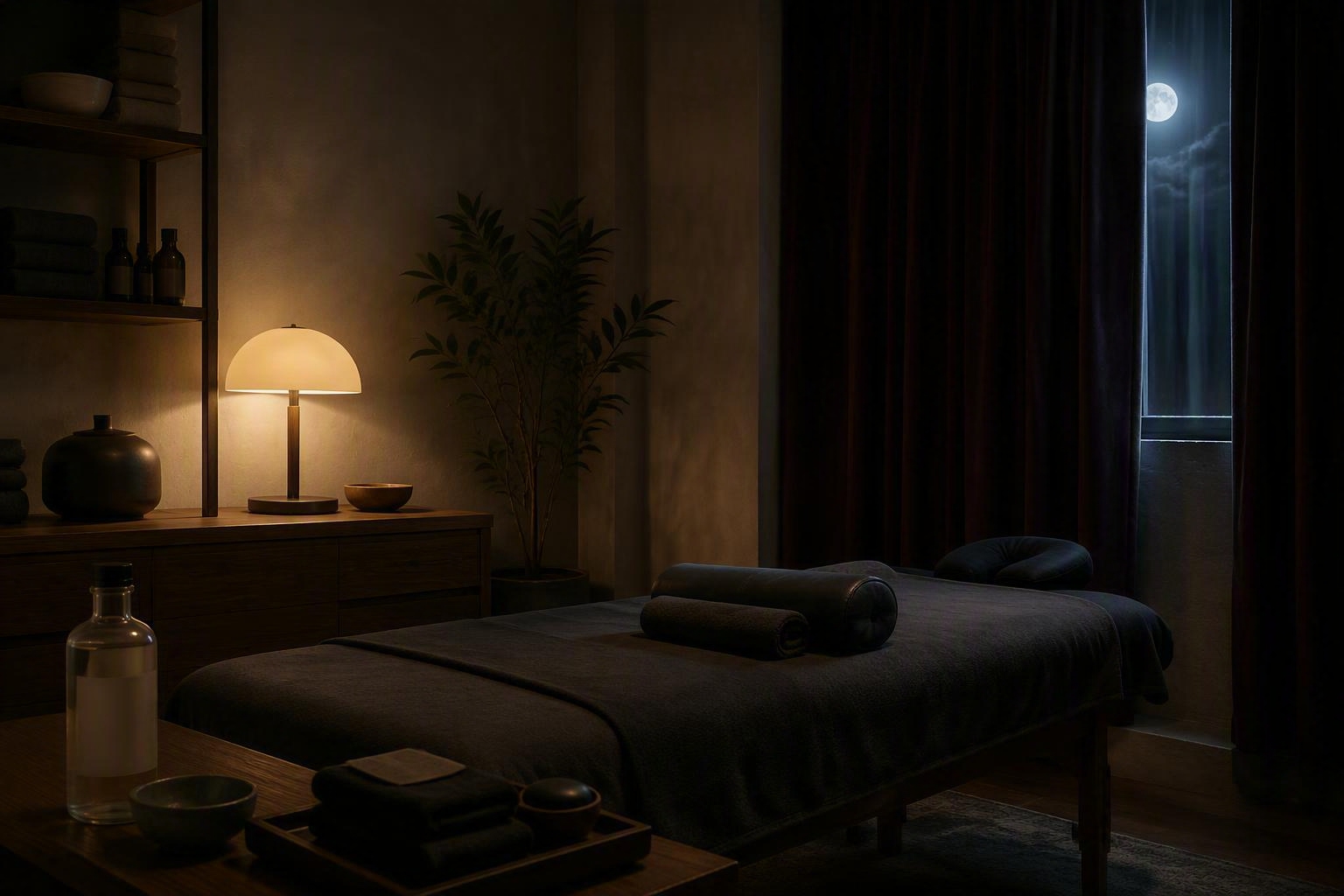
Dim lighting is welcome, but complete darkness complicates the therapist’s work. The client may not need visual orientation. The practitioner does.
And the neck?
Professionally, the neck is still a neck.
Fictionally, the carotid area is not casual territory.
In mythology, the neck carries extra meaning. Good practice remains the same: explain what area you intend to work, ask permission, and avoid turning a sensitive region into a surprise.
The most fitting approach: slow, deep work with mobility.
A session might combine broad myofascial-style pressure, deep but controlled muscular work, assisted shoulder and hip mobility, and enough Swedish-style integration to keep the experience from feeling like maintenance on a cathedral gargoyle.
Thai-style assisted stretching could also work beautifully for an ancient client with severe movement monotony—provided supernatural joint range does not become an excuse for spectacular over-stretching.
Final note for reception
Book after sunset. Use unscented products. Do not promise circulation benefits. Allow extra time for a very old intake history. Keep mirrors optional. Confirm whether the client prefers a heated table or merely finds warmth nostalgic.
And possibly keep the therapist’s snack break private.
The unfamiliar body still deserves ordinary professionalism. Once the jokes about fangs and coffins are finished, the logic is familiar: understand the body in front of you, question assumptions, communicate clearly, and adapt technique to the client, not the other way around.
If all else fails, try not to reflect on it too much, especially if there is a mirror in the room.
This is surprisingly disciplined beneath the comedy. The vampire is never treated as the joke; the assumptions are. That distinction is why the ending about ordinary professionalism lands. Also, I would strongly discourage putting “unblock your flows of rejuvenating energy” on the brochure.